Many of us have been enjoying dry and sunny days over the last few weeks, with rainfall in both March and April having been well below average, according to The Met Office - the provisional total for March and April is 77.3mm, which is just 49.3% of the 1991 to 2020 average.
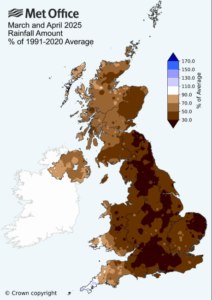 Image: Met Office website
In many parts of the UK, the land is already looking parched and water levels are dropping in reservoirs - and the BBC reported this morning that there’s no sign of significant rainfall in the short-term weather forecast. The dry weather is expected to continue for at least the next ten days.
This is already affecting some business sectors, such as the agricultural sector, where farmers who heavily rely on water for livestock and irrigation have had an earlier start to the irrigation season. It’s also affecting arable farmers. BBC radio presenter, Steve Harris, spoke to one arable farmer from Dorset who said ‘the weather over the next 10 days will make the difference between us having a reasonable crop to harvest, and a disastrous crop due to the lack of moisture’.
With summer approaching, the Environment Agency (EA) is stepping up its preparation for potential water shortages with enhanced monitoring of river, groundwater and reservoir levels, and is calling on water companies to act to help customers use water wisely and reduce leakage themselves. Water Minister, Emma Hardy, said ‘water companies must go further and faster to cut leaks and build the infrastructure to secure our water supply’.
Many businesses consume significant amounts of water, such as those in hospitality, where hotels use water for laundry services and showering in guest bedrooms, and factories and processing plants where water is essential for cooling products, processing ingredients and cleaning machinery. Conserving water is not only an environmental responsibility, but can also lead to cost savings and operational efficiency. In this blog, we’re going to take a look at how businesses can work at reducing water consumption.
Some water-saving quick wins
Thousands of litres of water can be saved, for instance in industrial settings, by fixing minor leaks quickly, and even small drips can add up to a significant amount of water wastage over time.
A regular inspection should be part of a routine maintenance schedule which will help ensure everything is working as it should and water isn’t wasted through improper use or wear and tear.
Make sure to regularly check for any issues such as dripping taps or leaks, so they can be identified and fixed promptly. Leak sensors, monitors and alarms can be installed that detect small leaks and changes in flow rates, nipping problems in the bud early.
Look to reduce window cleaning in the summer months, and collect rainwater in butts and reuse for purposes such as watering thirsty plants.
Promote water saving amongst employees
Water is a precious resource that we can often take for granted, and as the UK population grows, water demand is escalating.
We can all do our bit to conserve water both at home and at work – small actions can make a big impact when adopted across an entire organisation. Savings can be made by getting staff onboard, educating employees and promoting water-saving behaviour, making them aware of the water-saving measures they can take in their day-to-day activities. Put posters up in rest rooms and kitchens to increase awareness about using water wisely.
Adopting simple habits such as collecting cold water while waiting for it to run hot, not leaving the tap running whilst washing hands, turning it off properly after use, reporting issues such as a dripping tap or a running toilet immediately, only putting the dishwasher on when it's full, and laundering full loads for those in businesses such as hospitality and care homes can make a real difference.
Install water-efficient fixtures
Businesses can significantly reduce water consumption without compromising functionality by installing water-efficient fixtures.
According to the FSB (Federation for Small Businesses), replacing taps within your premises with spray taps will reduce the volume of water that comes out of the taps.
Installing low-flow taps or an aerator, a small device attached to the tip of a tap that mixes air with the water flow, creating a smooth controlled stream that uses less water, and low flow shower heads are simple and inexpensive ways to reduce water usage significantly in businesses that require a lot of hand washing, such as in the catering and hospitality sectors.
Reuse and recycle
Consider grey water systems for flushing toilets or for irrigation systems. These are recycling systems that collect lightly used water from sources such as sinks, laundry facilities, baths and showers or cooling or rinsing processes in manufacturing. They filter out debris, soaps, and particulates by passing the water through a multi-stage filtration system so the filtered water, whilst not clean enough for drinking, can still be reused, for instance, in crop-growing or for landscaping or cooling.
Then there are closed-loop water systems, which can reduce overall consumption in industrial processes and are commonly found in heating, ventilation, and air conditioning systems. Water continually flows through a sealed loop of pipes and equipment, without being exposed to the atmosphere, with the same water being treated, reused, and recirculated.
Upgrade equipment
For those in businesses that use industrial washing machines or dishwashers, there are models available with smarter water distribution that are specifically designed to reduce water usage. And for those in hospitality, energy efficient ice makers minimise water-to-ice loss by producing ice cubes with less runoff.
Switching to energy-efficient devices can not only reduce water consumption but can also lower utility bills and support sustainability goals without sacrificing performance or reliability.
With business usage accounting for nearly a third of all water demand in England according to Yorkshire Water, small changes in the workplace can really make a huge difference and have a significant impact on water conservation.
And whilst our focus is firmly planted is on conserving this precious commodity, there are other benefits to be achieved when reducing water consumption, such as increasing sustainability and improving your business's environmental credentials, and reducing energy costs. Whether your business is powered by mains gas, commercial LPG (liquified petroleum gas), oil or any other energy source, in these times of rising prices, all businesses are looking to save costs in any way they can. Reducing water usage, especially for those businesses with high consumption, helps reduce operating costs and helps them to run smarter and more sustainably.
As we’ve already touched on, for rural off-grid businesses, using less water often means lower energy costs too. For those who currently use oil as an energy source, savings can be made by switching to LPG, a versatile, highly efficient fuel source which is also clean-burning so can help your business reduce its carbon footprint. Plus renewable gases such as BioLPG and rDME are coming soon.
If you’d like to discuss switching to LPG, contact our friendly team today on 01423 772 789. We’re here to help, will talk you through the benefits of switching to LPG and help you get the ball rolling. You can be sure you're in safe hands with Northern Energy Gas.