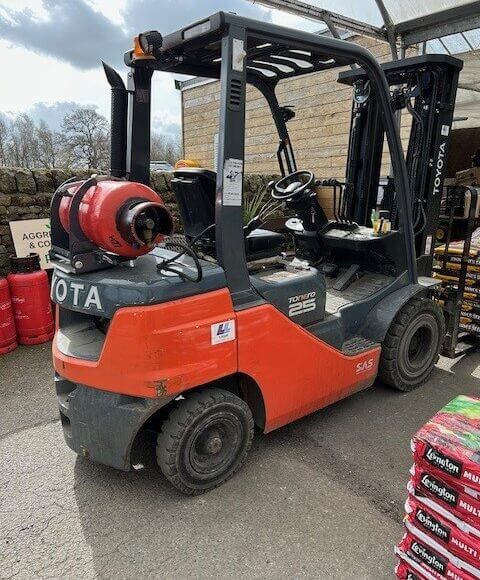
Forklift trucks are essential equipment in any business where the efficient movement of goods is required.
For businesses that rely on forklift trucks (FLT’s), whether in hospitality, farming and agriculture, industry and manufacturing, or any other sector, when shopping for a new machine, choosing the right one for your business is a crucial decision that can impact productivity, efficiency, and overall operational costs.
One important consideration is the energy source for your forklift, with the most popular being electric, diesel, and LPG (liquid propane gas), and choosing the appropriate forklift power source is also essential for operational safety.
Each type has its advantages and disadvantages, and selecting the right type for your business and operations will depend on several factors such as upfront costs, ongoing cost considerations, the operating environment, and your specific requirements.
In this blog, we’re going to take a look at the pros and cons of each to help you make informed decisions and ensure you’ll be suitably equipped with the right machine for your business’s individual needs.
Let’s start by looking at initial upfront costs:
The initial price tag
Typically, electric forklifts are more expensive to purchase outright when compared to their fossil-fuel counterparts, although costs will vary depending on capacity, brand and features. Some suppliers include the battery and charger, but others charge for these separately. Electric forklifts require dedicated charging areas with proper ventilation, and batteries will need replacing over time.
Next in line are diesel forklifts, which can often be cheaper to purchase initially and remain a popular choice. They differ from electric versions as no significant additional equipment is required for fuelling, but are not suitable for every business and working environment.
LPG trucks are generally lower in cost than both diesel or electric alternatives, which can be a significant factor for businesses on a tight budget. A designated refuelling area will be required in an open, well-ventilated area away from buildings and ignition sources.
But let’s not forget that owning an FLT extends beyond the initial price tag, and long-term costs are more important overall than just the purchase price.
Looking beyond the upfront costs
Day-to-day fuel and maintenance costs can greatly affect your ongoing forklift ownership costs.
Electric FLT’s are energy-efficient and cheap to run. They also require less maintenance than diesel and LPG models, as there are fewer moving parts and they don’t require engine oil or coolant fluids. However, batteries must be routinely recharged by a competent person, and recharging times can be long, with lead-acid batteries typically taking between 8 and 12 hours to fully charge. This can result in costly downtime.
Ongoing costs with diesel FLT’s include fuel, maintenance, and repairs. Fuel costs have been particularly volatile over recent times, and as they run on a fossil fuel, diesel engines produce significant emissions, including greenhouse gases such as CO2, which is bad for the environment. Regular maintenance, including regular oil changes and filter replacements, is crucial for keeping your diesel forklift running efficiently. However, refuelling is quick, so there’s limited downtime.
Running costs for FLT’s fuelled by liquid petroleum gas include, servicing, regular maintenance, repairs, and fuel, which is cheaper than diesel. LPG trucks typically cost less to maintain than their diesel equivalents as LPG is cleaner-burning and produces fewer pollutants and virtually no particulate matter, so is kinder to engines. Plus, refuelling can be done in a matter of minutes, with no batteries to charge, helping to keep up productivity and reduce unwanted downtime.
Making the right choice for your day-to-day operations
With a wide range of models and different fuel options available, choosing the right forklift truck for your business should be based on your specific industry requirements, site layout, workload, budget and regulatory obligations. For instance, is it for indoor use, outdoor use, or both? What are your operating hours? What ventilation is available and are there any temperature extremes such as cold storage to consider?
It’s important to determine required load size and capacity - the maximum weight you will need the forklift to lift can have an implication on your choice. Diesel forklifts, which are generally more durable and powerful, have high torques, so are ideal for housing developers or in farming where there are heavy loads and rough outdoor terrain and rugged environments. However, they can be noisy when operated, and emit high levels of emissions so indoor use is basically a no-no.
Electric forklifts have limited outdoor use – batteries hate wet conditions unless specifically weatherproofed. But they’re particularly suited for indoor use, such as in warehouses, are extremely manoeuvrable, energy efficient, super quiet and give off zero emissions at point of use. They do, however, have a limited range due to the life of their batteries, limited use on gradients and flows such as shale or hard-standing and performance isn’t as high as with engine-powered FLT’s.
Forklifts that run on commercial gas are highly versatile and can be used both indoors and outdoors subject to good ventilation. They provide good power-to-weight ratio, offering a balanced combination of fuel efficiency and consistent power delivery. Whilst they do still emit carbon dioxide, they emit much lower emissions than diesel so can help businesses reduce their environmental impact and carbon footprint.
As well as lower upfront costs than diesel or electric FLT’s, they are highly versatile, offering a balanced combination of fuel efficiency and consistent power delivery both indoors, provided there is adequate ventilation, and outdoors. Their adaptability makes them a practical choice for a wide range of mixed-use environments that need flexibility, such as warehouses, factories and distribution centres with diverse operational needs, in logistics, and crop growing, such as potato production. Plus, there's no risk of disruption due to a power cut and no risk of a fuel spillage - diesel is highly flammable and can pose a serious fire risk. Instead, LPG cylinders, which should be stored in line with regulations, are refilled from a bulk LPG tank Just some of the reasons why they're fast becoming one of the more popular types of FLT’s.
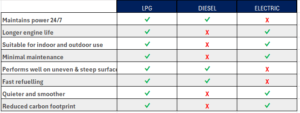
We summarise of the pros and cons
Contact us to switch to LPG
If you’re looking to purchase a forklift truck for your business and you're interested in finding out more about LPG, contact us on 01423 772 789. Our expert customer service and in-house engineering teams fully understand your business needs, and will put all their energy into listening to your requirements and tailoring our solutions into helping you make your business a success.
If you're new to LPG forklifts, we will work with you to ensure you have a smooth transition, Our in-house qualified GAS SAFE engineers will install a bulk LPG tank on your premises, we will train your staff and ensure your business has a reliable supply with our regular top-up service and ongoing aftercare. All ensuring your business experiences the full benefit of reduced downtime.