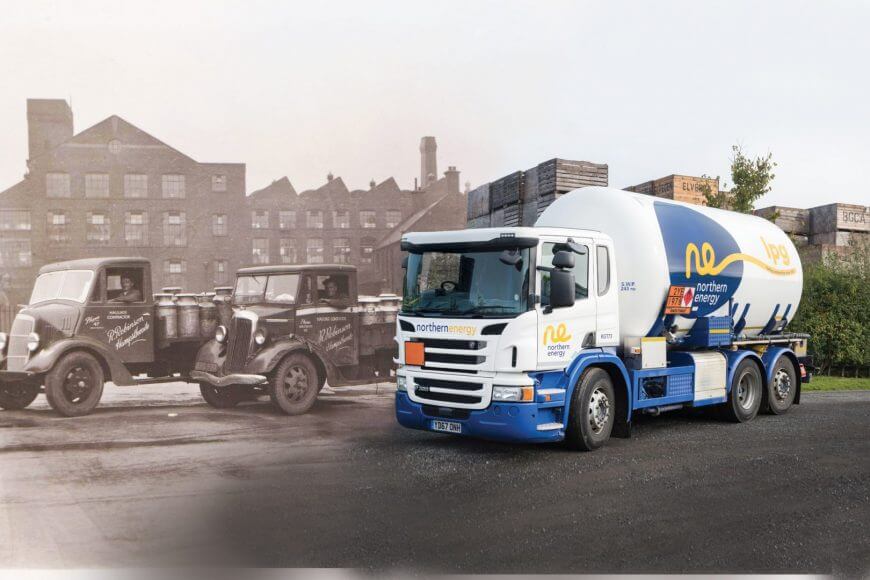
Off-Grid Before It Was Cool: The Hidden History of LPG
It's hard to imagine that one of the most reliable off-grid energy sources started life as little more than an industrial byproduct of refining crude oil. Yet that’s the story of LPG – a fuel once overlooked, that is now a cornerstone of independent living. What began as surplus gas from crude oil refining and natural gas extraction has become a lifeline for thousands of rural farms, care homes, housing developers and other businesses throughout the UK.
Even as the world accelerates towards electrification and emerging green technologies, LPG continues to play a vital role, reliably fuelling heating, cooking, and operations where other energy sources simply aren’t practical or available. Its longevity is testament to its adaptability, versatility, and efficiency, and innovations like bioLPG and rDME are shaping its low-carbon future.
At Northern Energy Gas, as an independent LPG supplier supporting off-grid customers across the UK, we’ve seen first-hand how this historic fuel keeps evolving – bridging the gap between today’s energy needs and tomorrow’s cleaner solutions.
Origins of LPG (Early 1900s)
Back in the early 1900s, scientists noticed that some of the lighter hydrocarbons released during the refining of oil and natural gas, such as propane and butane, would condense into liquid form when stored under pressure.
It was in 1910 that American chemist Dr. Walter O. Snelling, when researching the properties of petrol, made a ground-breaking discovery. While investigating why gasoline seemed to ‘evaporate’ so quickly from storage containers, he realised the escaping vapour could be captured, liquified at reasonable pressures, and used as a clean, efficient fuel. This discovery marked the birth of Liquified Petroleum Gas (LPG).
Two years later, Snelling completed his first domestic propane installation, and in 1913, he patented the industrial production of propane. That same year, the patent was acquired by Frank Philips, founder of ConocoPhillips, which today operates the Teesside Terminal at Seal Sands in Middlesbrough.
Initially, LPG was mainly used for stoves, heating systems, and for lighting. In a time before rural electrification, it offered something revolutionary: a portable, efficient, and reliable source of energy that could be stored, transported, and used almost anywhere, giving homes and businesses the freedom to cook, heat and operate independently, long before modern energy infrastructure arrived.
The Rise of LPG in the UK through the mid-20th century
LPG reached Europe in the mid-1930’s, imported from the United States. By the 1940’s, it had evolved far beyond its early domestic uses. During and after the 2nd world war, Britain faced the challenge of rebuilding and modernising – particularly in rural areas, where the mains gas grid often didn’t reach.
Post-war development in rural areas created a demand for a fuel that was versatile, efficient and easy to transport. LPG fitted the bill perfectly. Its portability and clean-burning nature made it an ideal choice for rural businesses and farms.
By the 1950s and 1960s, LPG was being increasingly being used for domestic cooking and heating, as well as in agriculture for crop drying and poultry rearing, and in industrial settings.
Fast-forward to today, and LPG has grown to be one of the most widely used off-grid fuels in Britain. According to Liquid Gas UK, the UK ranks 17th globally in total LPG consumption, with over 200,000 homes and thousands of businesses nationwide relying on the exceptional energy that is LPG.
Modernisation and Innovation: LPG in the UK, 1980s to 2000s
LPG underwent a period of rapid modernisation from the 1980s onwards, transforming from a convenient off-grid fuel to a highly versatile, technologically advanced energy solution. Advances in cylinder and bulk storage technology, along with the introduction of automatic top-up services, made LPG safer, more convenient, more reliable, and easier to manage for both homes and businesses.
At the same time, new, more efficient, lower-emission appliances were being developed and introduced to the market, positioning LPG as an environmentally friendly alternative to coal, oil or diesel.
During the 1990s, LPG found a new role as a vehicle fuel. Known as Autogas, it helped fleets and taxis reduce emissions while maintaining performance.
By the turn of the millennium, LPG had transitioned from a niche, convenient, and environmentally friendly fuel for remote homes and rural industries into a highly versatile, technologically advanced energy solution, ready to meet both modern convenience and environmental expectations.
Today’s Off-Grid Landscape
LPG has come a long way since its early days as a byproduct of oil refining. Today, its applications extend far beyond heating and cooking – fuelling everything from cars and hot air balloons to Olympic torches and even large-scale power generation plants.
Whether for rural homes, farms, hospitality venues, or industrial sites, LPG remains a reliable energy source, even in the remotest corners of the UK. Modern energy systems increasingly combine LPG with other technologies, from hybrid solar to air and ground source heat pumps, offering flexible, efficient energy solutions. And with renewable gases on the horizon, LPG’s role as a sustainable energy source continues to grow.
Looking ahead: LPG’s continuing evolution
From its accidental discovery in the early 1900s to powering rural homes, farms, and businesses today, LPG has proven itself adaptable, reliable and indispensable. Its evolution continues through cleaner technologies, innovative storage, and renewable gases, ensuring LPG remains a key part of the energy mix for the future.
For Northern Energy Gas, this reliability is particularly important across our core sectors – hospitality, care homes, housing developers, farming and poultry rearing, industrial processing and warehouses, to name a few. These customers rely on LPG where mains gas isn’t an option.
Adding to the optimism, the Government announced in its Carbon Budget Delivery Plan yesterday that it will not take forward the previous proposal to restrict fossil fuel heating in off-grid properties by 2026. The decision provides greater certainty for off-grid homes and businesses, reinforcing LPG’s role as a flexible, sustainable, and practical energy solution.
At Northern Energy Gas, as an independent, long-established supplier to rural businesses across all sectors, we've seen how LPG supports businesses that prioritise flexibility, reliability, and sustainability.
As our MD, Stuart Illingworth, says ‘We’ve seen first-hand how LPG has powered farms, workshops, and homes across the UK, often in places the mains grid still can’t reach. It’s more than just a fuel; it’s what keeps rural communities connected, resilient, and independent.’
LPG has been powering off-grid homes and businesses for over a century, and that story continues with you.
Call our friendly team today on 01423 772 789 (North) or 0118 229 4747 (South) to find out how switching to LPG can provide your business with reliable, independent energy.